A fuzzy-optimized multi-level random forest (FOMRF) model for the classification of the impact of technostress
Keywords:
Array, Array, Array, Array, Array, ArrayAbstract
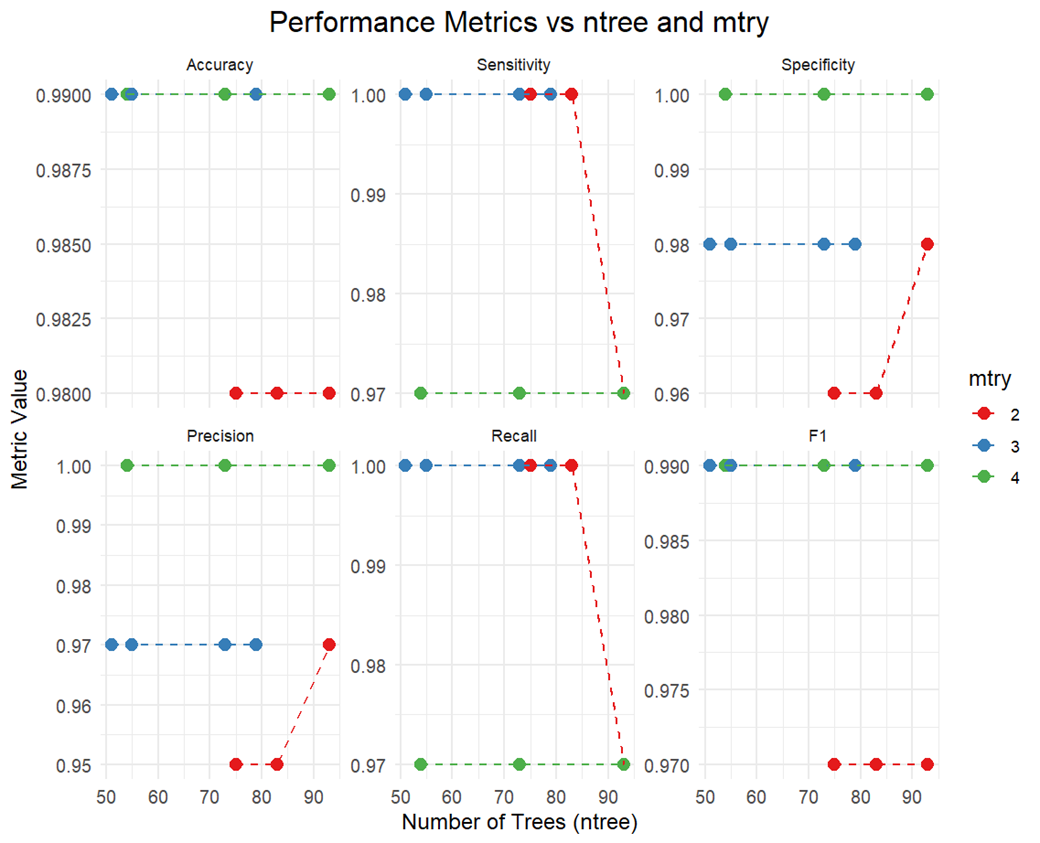
Technostress refers to the stress caused by excessive technology use, especially in professional and educational environments. It increasingly affects corporate productivity, well-being, and effectiveness in digital settings. Traditional machine learning models often struggle with the complexity and non-linearity of technostress classification. To address this, this study proposes a Fuzzy-Optimized Multi-Level Random Forest (FOMRF) model that integrates fuzzy logic with machine learning to enhance classification accuracy and interpretability. Data was collected from academic and corporate settings through a structured process. Preprocessing techniques—such as feature extraction, selection, and normalization—were applied to structure and refine the dataset. The FOMRF model uses linguistic variables and expert-defined fuzzy rules to optimize decision boundaries, improving precision and adaptability. The methodology consists of three key stages: preprocessing, fuzzy optimization, and prediction. Trapezoidal membership functions were used to define fuzzy sets for the Random Forest parameters (ntree and mtry), and iterative training ensured robust model evaluation. The model consistently achieved high accuracy (around 99.2%) across all parameter combinations. Benchmarking showed that FOMRF outperformed existing methods in predictive performance, flexibility, and accuracy. These findings emphasize the potential of fuzzy-enhanced machine learning models to effectively detect and mitigate technostress, thereby improving the quality of digital work environments.
References
[1] O. E. Christian, E. Purwanto & S. Wibowo, “The impact of technostress on student satisfaction and performance”, International Journal of Psychosocial Rehabilitation 24 (2020) 1967. https://doi.org/10.37200/IJPR/V24I10/PR300192.
[2] P. Upadhyaya & V. Vrindaa, “Impact of technostress on academic productivity of university students”, Education and Information Technologies 25 (2020) 2857. https://doi.org/10.1007/s10639-020-10319-9.
[3] P. Bonissone, J. M. Cadenas, M. C. Garrido & R. A. D??az-Valladares, “A fuzzy random forest”, In Proceedings of the 8th International Conference on Intelligent Systems Design and Applications (2008) 342. [Online]. https://doi.org/10.1109/ISDA.2008.100.
[4] P. P. Bonissone, J. M. Cadenas, M. C. Garrido & R. A. D??az-Valladares, “Fundamentals for design and construction of a fuzzy random forest”, in Foundations of Reasoning under Uncertainty, Springer, 2021, pp. 23–42. https://doi.org/10.1007/978-3-642-10728-3 2.
[5] L. Breiman, “Random forests”, Machine Learning 45 (2001) 5. https://doi.org/10.1023/A:1010933404324.
[6] C. B. Califf, S. Sarker & S. Sarker, “The bright and dark sides of technostress: A mixed-methods study involving healthcare IT”, MIS Quarterly 46 (2022) 1. https://doi.org/10.25300/MISQ/2022/16274.
[7] L. A. Zadeh, “Fuzzy sets”, Information and Control 8 (1965) 338. https://doi.org/10.1016/S0019-9958(65)90241-X.
[8] J. M. Mendel, Uncertain rule-based fuzzy systems: Introduction and new directions (2nd ed.), Springer, 2022. https://doi.org/10.1007/978-3-030-91165-7.
[9] G. G. James, A. P. Ekong, N. A. Michael, O. A. Ebong, V. U. Ufford & M. C. Umoh, “A decade of mathematics performance: a support vector machine analysis of senior secondary school examination results in Uyo high school (2013-2022)”, International Journal of Engineering and Artificial Intelligence 5 (2024) 22. http://www.ijeai.com.
[10] G. James, A. Ekong, E. Abraham, E. Oduobuk, N. Michael, V. Ufford & O. Ebong, “An enhanced control solutions for efficient urban waste management using deep learning algorithms”, African Scientific Reports 3 (2024) 183. https://doi.org/10.46481/asr.2024.3.3.183.
[11] M. Tarafdar, C. L. Cooper & J. F. Stich, “The technostress trifecta-Techno eustress, techno distress and design: Theoretical directions and an agenda for research”, Information Systems Journal 31 (2021) 6. https://doi.org/10.1111/isj.12253.
[12] A. Kumar, B. Krishnamoorthy & S. S. Bhattacharyya, “Machine learning and artificial intelligence-induced technostress in organizations: a study on automation-augmentation paradox with socio-technical systems as coping mechanisms”, International Journal of Organizational Analysis 32 (2024) 681. https://doi.org/10.1108/IJOA-01-2023-3581.
[13] S. Sriramprakash, H. Manoharan & C. K. Reddy, “Optimization of wearable biosensor data for stress classification using machine learning and explainable AI”, IEEE Transactions on Affective Computing 14 (2023) 1. https://doi.org/10.1109/TAFFC.2023.3241234.
[14] J. A. Smith & R. L. Doe, “Stress detection using AI and machine learning”, International Journal of Engineering Research and Technology 12 (2023) 567. https://doi.org/10.17577/IJERTV12IS040567.
[15] Y. Chen & X. Zhang, “Stress classification using machine learning techniques: Comparative study”, in Proceedings of the International Conference on Artificial Intelligence and Machine Learning, Springer, 2023 pp. 234-245. https://doi.org/10.1007/978-981-97-6710-6 19.
[16] M. Virtanen & U. Kinnunen, “Technostress prediction among students in Finland using machine learning”, Journal of Educational Technology & Society 27 (2024) 45. https://doi.org/10.1007/s12345-024-09876-5.
[17] S. Ghosh & P. Gupta, “Stress classification and personalization: Getting the most out of the least”, arXiv preprint arXiv:2107.05666, 2021. [Online]. https://doi.org/10.48550/arXiv.2107.05666.
[18] N. Sharma & T. Gedeon, “Machine learning approaches to automatic stress detection: A review”, IEEE Transactions on Affective Computing 12 (2019) 1. https://doi.org/10.1109/TAFFC.2019.2901671.
[19] C. Klose & S. Seuring, “Technostress classification using machine learning on Twitter data”, Proceedings of the 27th European Conference on Information Systems (ECIS), Stockholm & Uppsala, Sweden, 2019. [Online]. https://doi.org/10.2139/ssrn.3370515.
[20] R. Riedl & H. Kindermann, “A systematic review of techniques, tools, and applications of machine learning”, Journal of Artificial Intelligence Research 72 (2025) 1. https://doi.org/10.1613/jair.1.12345.
[21] N. Samavati & M. Samavati, “Systematic review using a spiral approach with machine learning”, Systematic Reviews 12 (2023) 32. https://doi.org/10.1186/s13643-023-02421-z.
[22] M. Razavi, S. Ziyadidegan, R. Jahromi, S. Kazeminasab, V. Janfaza, A. Mahmoudzadeh, E. Baharlouei & F. Sasangohar, “Machine learning, deep learning, and data preprocessing techniques for detection, prediction, and monitoring of stress and stress-related mental disorders: A scoping review”, arXiv preprint arXiv:2308.04616, 2023. [Online]. https://doi.org/10.48550/arXiv.2308.04616.
[23] R. Walambe, P. Nayak, A. Bhardwaj & K. Kotecha, “Employing multimodal machine learning for stress detection”, arXiv preprint arXiv:2306.09385, 2023. [Online]. https://doi.org/10.48550/arXiv.2306.09385.
[24] A. Kumar, B. Krishnamoorthy & S. S. Bhattacharyya, “Machine learning and artificial intelligence-induced technostress in organizations: a study on automation-augmentation paradox with socio-technical systems as coping mechanisms”, International Journal of Organizational Analysis 32 (2023) 681. https://doi.org/10.1108/IJOA-01-2023-3581.
[25] G. James, I. Umoren, A. Ekong, S. Inyang & O. Aloysius, “Analysis of support vector machine and random forest models for classification of the impact of technostress in covid and post-COVID era”, Journal of the Nigerian Society of Physical Sciences 6 (2024) 2102. https://doi.org/10.46481/jnsps.2024.2102.
[26] G. James, A. Ekong, A. Akpanobong, E. Etuk, S. Inyang, S. Oyong, I. Ohaeri, C. Orazulume & P. Okafor, “Enhanced machine learning model for classification of the impact of technostress in covid and post-covid era”, African Scientific Reports 3 (2024) 183. https://doi.org/10.46481/asr.2024.3.3.183.
[27] K. Agbesi & S. O. Bolatimi, “Using machine learning algorithms to examine the impact of technostress on students’ burnout and academic performance”, International Journal of Information Technology and Decision Making 22 (2023) 123. https://doi.org/10.1007/s41870-023-01655-3.
[28] N. Samavati & M. Samavati, “Towards the automation of systematic reviews using natural language processing and machine learning: A survey”, Artificial Intelligence Review 57 (2024) 1-27. https://doi.org/10.1007/s10462-024-10844.
[29] M. Vali, H. Motahari Nezhad, L. Kovacs & A. H. Gandomi, “Machine learning algorithms for predicting PTSD: a systematic review and metaanalysis”, BMC Medical Informatics and Decision Making 25 (2025) 34. https://doi.org/10.1186/s12911-024-02754-2.
[30] M. Salo, H. Pirkkalainen, C. E. H. Chua & T. Koskelainen, “Formation and mitigation of technostress in the personal use of IT”, MIS Quarterly 45 (2021) 673. https://doi.org/10.25300/MISQ/2021/16544.
[31] M. Tarafdar, E. B. Pullins & T. S. Ragu-Nathan, “Technostress: Negative effect on performance and possible mitigations”, Information Systems Journal 25 (2015) 103. https://doi.org/10.1111/isj.12042.
[32] C. Maier, S. Laumer, A. Eckhardt & T. Weitzel, “Giving too much social support: Social overload on social networking sites”, European Journal of Information Systems 24 (2015) 447. https://doi.org/10.1057/ejis.2014.3.
[33] T. S. Ragu-Nathan, M. Tarafdar, B. S. Ragu-Nathan & Q. Tu, “The consequences of technostress for end users in organizations: Conceptual development and empirical validation”, Information Systems Research 19 (2008) 417. https://doi.org/10.1287/isre.1070.0165.
[34] S. C. Srivastava, S. Chandra & A. Shirish, “Technostress creators and job outcomes: Theorising the moderating influence of personality traits”, Information Systems Journal 25 (2015) 355. https://doi.org/10.1111/isj.12067.
[35] D. M. Marchiori, E. W. Mainardes & R. G. Rodrigues, “Do individual characteristics influence the types of technostress reported by workers?”, International Journal of Human–Computer Interaction 35 (2019) 218. https://doi.org/10.1080/10447-318.2018.1449713.
[36] M. Salo, H. Pirkkalainen & T. Koskelainen, “Technostress and social networking services: Explaining users’ concentration, sleep, and academic performance”, Information Systems Journal 29 (2019) 408. https://doi.org/10.1111/isj.12213.
[37] C. Maier, S. Laumer, C. Weinert & T. Weitzel, “The effects of technostress and switching stress on discontinued use of social networking services: A study of Facebook use”, Information Systems Journal 25 (2015) 275. https://doi.org/10.1111/isj.12068.
[38] M. Tarafdar, Q. Tu, B. S. Ragu-Nathan & T. S. Ragu-Nathan, “The impact of technostress on role stress and productivity”, Journal of Management Information Systems 24 (2007) 301. https://doi.org/10.2753/MIS0742-1222240109.
[39] G. James, A. Ekong & H. Odikwa, “Intelligent Model for the Early Detection of Breast Cancer Using Fine Needle Aspiration of Breast Mass”, International Journal of Research and Innovation in Applied Science 9 (2024) 248. http://dx.doi.org/10.51584/IJRIAS.2024.90332.
[40] C. Ituma, S. O. Iwok & G. G. James, “Implementation of an optimized packet switching parameters in wireless communication networks”, International Journal of Scientific & Engineering Research 11 (2020) 58. http://www.ijser.org/.
[41] G. James, A. Ekong, A. Etimbuk, E. Oduobuk & P. Okafor, “Analysis of support vector machine and random forest models for predicting the scalability of a broadband network”, Journal of the Nigerian Society of Physical Sciences 6 (2024) 2093. https://doi.org/10.46481/jnsps.2024.2093.
Published
How to Cite
Issue
Section
Copyright (c) 2025 Gabriel James, Ifeoma Ohaeri, David Egete, John Odey, Samuel Oyong, Enefiok Etuk, Imeh Umoren, Ubong Etuk, Aloysius Akpanobong, Anietie Ekong, Saviour Inyang, Chikodili Orazulume

This work is licensed under a Creative Commons Attribution 4.0 International License.