HybOptic-CNN: A hybrid WOA-GWO-optimized convolutional neural network model for enhanced plant disease detection in the Nigerian environment
Keywords:
Plant disease detection, Convolutional neural network, Hybrid optimization, Whale Optimization Algorithm, Grey Wolf OptimizerAbstract
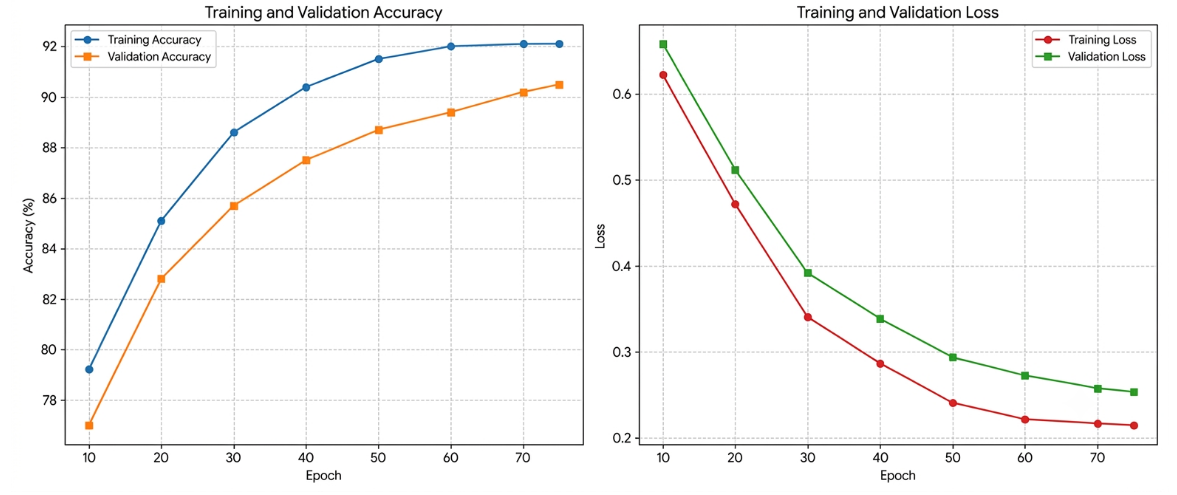
Plant diseases threaten agricultural productivity, and automated image analysis can support early identification of visible disease symptoms. This study introduces HybOptic-CNN, a convolutional neural network (CNN) whose learning rate and batch size are selected using a hybrid Whale Optimization Algorithm--Grey Wolf Optimizer (WOA-GWO). Nine disease classes were selected from the 22-class CCMT field-image dataset, and 152 local farm leaf images were collected in Enugu State, Nigeria. Of the local images, 122 (80.3%) were added to the model-development data for training and validation, whereas 30 (19.7%) formed an independent Nigerian hold-out set excluded from augmentation, class balancing, early stopping, validation, and hyperparameter selection. Across 10 model-development runs, the optimized model achieved 96.8 ± 0.4% mean validation accuracy, 95.2 ± 0.5% macro-precision, 94.9 ± 0.6% macro-recall, and 95.0 ± 0.5% macro-F1, compared with 90.3 ± 0.9% validation accuracy and 86.3 ± 1.2% macro-F1 for the baseline. The optimized model improved mean validation accuracy by 6.5 percentage points and converged 14.6 epochs earlier. On the independent 30-image Nigerian hold-out, HybOptic-CNN achieved 93.3% accuracy and 93.1% macro-F1 across four represented disease classes. A web application integrating the trained classifier was also demonstrated. These results support improved model-development performance through hybrid hyperparameter selection and motivate broader multi-location field evaluation.
References
[1] T. D. Salka, M. B. Hanafi, S. M. S. A. A. Rahman, D. B. M. Zulperi & Z. Omar, ``Plant leaf disease detection and classification using convolution neural networks model: a review'', Artificial Intelligence Review 58 (2025) 322. https://doi.org/10.1007/s10462-025-11234-6.
[2] A. Y. Ashurov, M. S. A. M. Al-Gaashani, N. A. Samee, R. Alkanhel, G. Atteia, H. A. Abdallah & M. S. A. Muthanna, ``Enhancing plant disease detection through deep learning: a depthwise CNN with squeeze and excitation integration and residual skip connections'', Frontiers in Plant Science 15 (2025) 1505857. https://doi.org/10.3389/fpls.2024.1505857.
[3] D. Devarajan, R. Allafi, M. Obayya & N. Nemri, ``AI based real time disease diagnosis in plants using deep learning driven CNNs'', Scientific Reports 16 (2026) 4587. https://doi.org/10.1038/s41598-025-34681-1.
[4] J. Chen, D. Zhang & Y. A. Nanehkaran, ``Using deep transfer learning for image-based plant disease identification'', Computers and Electronics in Agriculture 173 (2020) 105393. https://doi.org/10.1016/j.compag.2020.105393.
[5] C. Pal, S. Karmakar, I. Mukherjee & P. P. Chakrabarti, ``A lightweight and explainable CNN model for empowering plant disease diagnosis'', Scientific Reports 15 (2025) 30720. https://doi.org/10.1038/s41598-025-94083-1.
[6] R. Jothilakshmi & R. Sharanesh, ``Automated plant disease detection using deep learning architectures with autonomous rover'', International Journal of Recent Technology and Engineering 9 (2020) 248. https://doi.org/10.35940/IJRTE.B3469.079220.
[7] R. Deng, M. Tao, H. Xing, X. Yang, C. Liu, K. Liao & L. Qi, ``Automatic diagnosis of rice diseases using deep learning'', Frontiers in Plant Science 12 (2021) 701038. https://doi.org/10.3389/fpls.2021.701038.
[8] P. Pai, S. Amutha, S. Patil, T. Shobha, M. Basthikodi, B. M. A. Shafeeq & A. P. Gurpur, ``Deep learning-based automatic diagnosis of rice leaf diseases using ensemble CNN models'', Scientific Reports 15 (2025) 27690. https://doi.org/10.1038/s41598-025-13079-z.
[9] T. Nyawose, R. C. Maswanganyi & P. Khumalo, ``A review on the detection of plant disease using machine learning and deep learning approaches'', Journal of Imaging 11 (2025) 326. https://doi.org/10.3390/jimaging11100326.
[10] C. Dhakhinamoorthy, S. K. Mani, S. K. Mathivanan, S. Mohan, P. Jayagopal, S. Mallik & H. Qin, ``Hybrid whale and gray wolf deep learning optimization algorithm for prediction of Alzheimer's disease'', Mathematics 11 (2023) 1136. https://doi.org/10.3390/math11051136.
[11] M. Murugaiah & M. Ganesan, ``A hybrid Grey Wolf-Whale optimization algorithm for classification of Corona virus genome sequences using deep learning'', The International Arab Journal of Information Technology 20 (2023) 331. https://doi.org/10.34028/iajit/20/3/5.
[12] D. Thakur, S. Dangi & P. Lalwani, ``A novel hybrid deep learning approach with GWO-WOA optimization technique for human activity recognition'', Biomedical Signal Processing and Control 99 (2025) 106870. https://doi.org/10.1016/j.bspc.2024.106870.
[13] B. R. Ramana Reddy, G. Kalnoor, M. Devashish & P. S. K. Reddy, ``Deep learning based mobile application for automated plant disease detection'', IEEE Access 13 (2025) 107917. https://doi.org/10.1109/ACCESS.2025.3581099.
[14] J. J. Kennedy & G. Chelladurai, ``AI-powered deep learning web application for automated plant disease diagnosis with rich visual analytics'', Intelligent Agriculture 1 (2025) 12. https://doi.org/10.54963/ia.v1i2.1665.
[15] G. Karuna, C. Eshwar, Y. S. Bharath, D. Rohan, H. D. Sharma & S. M. N. Raja, ``An automated system to detect plant disease using deep learning'', E3S Web of Conferences 430 (2023) 01044. https://doi.org/10.1051/e3sconf/202343001044.
[16] S. Chandrasekaran, V. Rohan, B. N. Reddy & D. K. Krishna, Enhanced deep learning model for automated plant disease classification, 3rd International Conference on Optimization Techniques in the Field of Engineering (ICOFE), 2024, pp. 1--19. https://doi.org/10.2139/ssrn.5088981.
[17] R. Sujatha, S. Krishnan, J. M. Chatterjee & A. H. Gandomi, ``Advancing plant leaf disease detection integrating machine learning and deep learning'', Scientific Reports 15 (2025) 11552. https://doi.org/10.1038/s41598-024-72197-2.
[18] S. Wang, D. Xu, H. Liang, Y. Bai, X. Li, J. Zhou, C. Su & W. Wei, ``Advances in deep learning applications for plant disease and pest detection: a review'', Remote Sensing 17 (2025) 698. https://doi.org/10.3390/rs17040698.
[19] A. Upadhyay, N. S. Chandel, K. P. Singh, S. K. Chakraborty, B. M. Nandede, M. Kumar, A. Subeesh, K. Upendar, A. Salem & A. Elbeltagi, ``Deep learning and computer vision in plant disease detection: a comprehensive review of techniques, models, and trends in precision agriculture'', Artificial Intelligence Review 58 (2025) 92. https://doi.org/10.1007/s10462-024-11100-x.
[20] I. Pacal, I. Kunduracioglu, M. H. Alma, M. Deveci, S. Kadry, J. Nedoma, V. Slany & R. Martinek, ``A systematic review of deep learning techniques for plant diseases'', Artificial Intelligence Review 57 (2024) 304. https://doi.org/10.1007/s10462-024-10944-7.
[21] M. Shoaib, A. Sadeghi-Niaraki, F. Ali, I. Hussain & S. Khalid, ``Leveraging deep learning for plant disease and pest detection: a comprehensive review and future directions'', Frontiers in Plant Science 16 (2025) 1538163. https://doi.org/10.3389/fpls.2025.1538163.
[22] Y. Borhani, J. Khoramdel & E. Najafi, ``A deep learning based approach for automated plant disease classification using vision transformer'', Scientific Reports 12 (2022) 11554. https://doi.org/10.1038/s41598-022-15163-0.
[23] D.-C. Rodr'iguez-Lira, D.-M. C'ordova-Esparza, J. M. 'Alvarez-Alvarado, J. Terven, J.-A. Romero-Gonz'alez & J. Rodr'iguez-Res'endiz, ``Trends in machine and deep learning techniques for plant disease identification: a systematic review'', Agriculture 14 (2024) 2188. https://doi.org/10.3390/agriculture14122188.
[24] F. O. Isinkaye, M. O. Olusanya & P. K. Singh, ``Deep learning and content-based filtering techniques for improving plant disease identification and treatment recommendations: a comprehensive review'', Heliyon 10 (2024) e29583. https://doi.org/10.1016/j.heliyon.2024.e29583.
[25] M. Islam, A. K. M. Azad, S. E. Arman, S. A. Alyami & M. M. Hasan, ``PlantCareNet: an advanced system to recognize plant diseases with dual-mode recommendations for prevention'', Plant Methods 21 (2025) 52. https://doi.org/10.1186/s13007-025-01366-9.
[26] P. K. Mensah, V. Akoto-Adjepong, K. Adu, M. A. Ayidzoe, E. A. Bediako, O. Nyarko-Boateng, S. Boateng, E. F. Donkor, F. U. Bawah, N. S. Awarayi, P. Nimbe, I. K. Nti, M. Abdulai, R. R. Adjei, M. Opoku, S. Abdulai & F. Amu-Mensah, ``CCMT: dataset for crop pest and disease detection'', Data in Brief 49 (2023) 109306. https://doi.org/10.1016/j.dib.2023.109306.
Published
How to Cite
Issue
Section
Copyright (c) 2026 Lois Onyejere Nwobodo, Chinonso J. Okonkwo, Edith Angela Ugwu, Udeh Chukwuma Callistus, Okorie Kingsley Maduabuchi, Ngene John Ndubisi, Agbo Kenechukwu Martin (Author)

This work is licensed under a Creative Commons Attribution 4.0 International License.